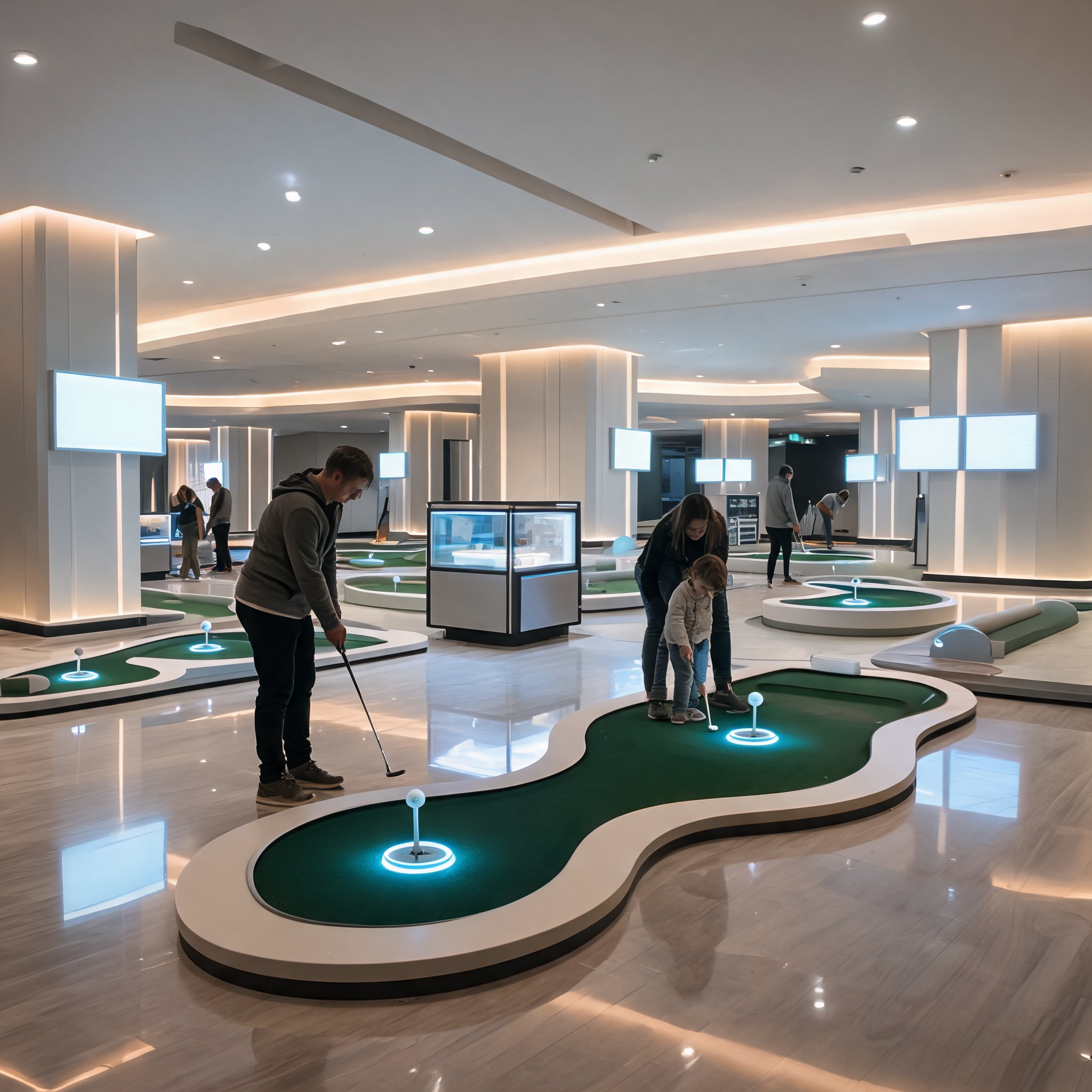
360Golf, the Holovis brand built around a technology-enhanced mini-golf format, is positioning itself less as a new leisure attraction than as a connected game platform. The distinction matters. Mini golf already has broad recognition and a low barrier to entry; 360Golf adds automated scoring, gamified features and an analytics layer intended to make the familiar format more competitive, more measurable and more repeatable for operators.
The core experience is deliberately simple. Players register, receive an assigned smart ball and begin play. Smart balls, tees and cups work with the HoloTrac scoring system, removing paper scorecards and providing an automated referee. On top of that sit SuperShots, Triumphs, bonuses, on-course games, player accounts, achievements, leaderboards and video celebrations. These elements are designed to give guests more reasons to compete, celebrate, compare scores and return.
A familiar game with a technical layer
360Golf's argument is that familiarity is an advantage rather than a limitation. Stuart Edgington, Holovis' global director of business development, says mini golf is already one of the world's most accessible leisure activities and does not need its fundamental appeal reinvented. The technology is meant to build on that base understanding, making play more interactive and giving operators more measurable commercial value.
That positioning also widens the addressable audience. The company says the format can appeal to families, competitive-socialising young adults and corporate groups, and can act as an anchor attraction that brings different demographics into a venue. Because the system requires little explanation or staff time at the point of play, operators can focus staff on guest management, food and drink, and service rather than on teaching the game or manually scoring it.
From scoring to repeat play
The automated scoring layer is the foundation, but the repeat-visit proposition comes from the gamification around it. SuperShots offer alternative ways to score; Triumphs present awards and unlock new challenges; bonuses, on-course games and achievements add further objectives. Player accounts and leaderboards let guests track progress across visits, while video celebrations give them something to share or remember.
The commercial logic is to turn a short social game into a series of small, legible achievements. Matt Dobbs, 360Golf's business development director, says the system gives players more reason to compete, celebrate and compare scores at the end of a game, and therefore more reason to come back. That is a plausible engagement loop, though the available figures do not show how much repeat visitation the features generate.
Data, throughput and secondary spend
Behind the player-facing features is DeepSmarts, an AI engine that supplies Holovis and operators with analytics. The company says the data can support product development, venue operations, seasonality planning and promotions, and can help engineers diagnose course problems remotely by reviewing what happened. For multi-site operators, the same platform can also help maintain consistency while allowing variation in theming, layout or branding.
360Golf says the attraction is designed to increase dwell time and secondary spend, with capacity optimised for up to 80 people per hour per course. At Butlin's PLAYXPERIENCE in Bognor Regis, where a £15m indoor activity centre opened in 2024 with three nine-hole 360Golf courses, Dobbs says the tech-putt offering has exceeded the client's expectations: 5,000 players a week in busy weeks and around £40,000 in weekly revenue. Those figures indicate strong demand at one site, but they are company-reported and do not by themselves prove that gamification caused the revenue result.
The operational model matters here. A kiosk-led, self-scoring system can reduce staff involvement in play and free the team to manage crowds and sell food and drink. The company presents that as a route to higher F&B revenue, but the outcome will still depend on venue location, pricing, audience mix, course capacity and service quality. None of those variables is benchmarked in the available material.
Flexible formats, one core platform
360Golf's deployment options are broad. Operators can retrofit technology into an existing mini-golf attraction, choose from catalogue holes, or commission a fully custom course. The company says tech-only installations take about six to eight weeks, catalogue holes can be installed and ready to play in eight to 12 weeks, and custom courses can take upwards of six months.
The examples show how far the format can stretch. For Norwegian Cruise Line, the Tee Time courses use marine-grade, IP-rated technology, including rugged cups and tees and specialist screens, to deliver the same experience at sea. At Netflix House, the Top 9 course is a fully custom, IP-led installation with unique hole designs and interactive elements themed around properties such as One Piece, Squid Game and Floor is Lava. At Lucky Duck in Norway, a custom course offers two routes for each hole, adding a new dimension of play while making use of the available space. Smaller venues can use a simpler or more cost-effective course design while retaining the scoring and replayability of the core system.
That flexibility is central to the business case. A multi-site operator can standardise the technology and then vary the creative layer; a single venue can start with a retrofit and expand later. The platform is therefore less a fixed product than a set of components: scoring hardware, game software, data services and course design, combined according to the site.
What the model can and cannot prove
The available account makes a strong case that 360Golf addresses a real operator problem: competitive socialising venues need activities that are easy to understand, quick to start and capable of generating repeat visits and secondary spend. It also shows that the company has moved beyond a single format, with installations across the UK, Europe, the Middle East, North America and Asia Pacific, and applications ranging from family entertainment centres to cruise ships and IP-led attractions.
What it does not establish is universal causation. The available evidence is largely company-provided and client-anecdotal. Butlin's performance is a useful signal, but it is one site with a new £15m activity centre and a mixed offer. The claim that gamification and data analytics lift dwell time, F&B revenue and ROI is commercially logical and supported by design choices, yet the available material does not provide controlled comparisons or independent performance data. Operators would still need to test the model against their own catchment, pricing and throughput assumptions.
A platform looking beyond mini golf
Holovis is also exploring adjacencies. The team is working with Roxy Leisure to add stroke-counting technology to crazy pool tables, and project manager Maaz Ussen says the ambition is to implement the technology in other sports. Edgington expects competitive socialising eventually to reach peak saturation, which makes the search for new markets and new applications a sensible hedge rather than a distraction.
The immediate task is commercial rollout. 360Golf is due to appear at the Land Leisure & Tourism Show on 4-5 November at NEC Birmingham and at IAAPA Expo in Orlando on 16-20 November, where operators can see the system and book a playable demonstration. The pitch is turnkey: discuss the venue, the audience and the commercial model, then decide how much course, technology and theming the site can support. Whether that pitch scales will depend less on novelty than on whether the platform reliably turns a familiar game into measurable, repeatable visits.