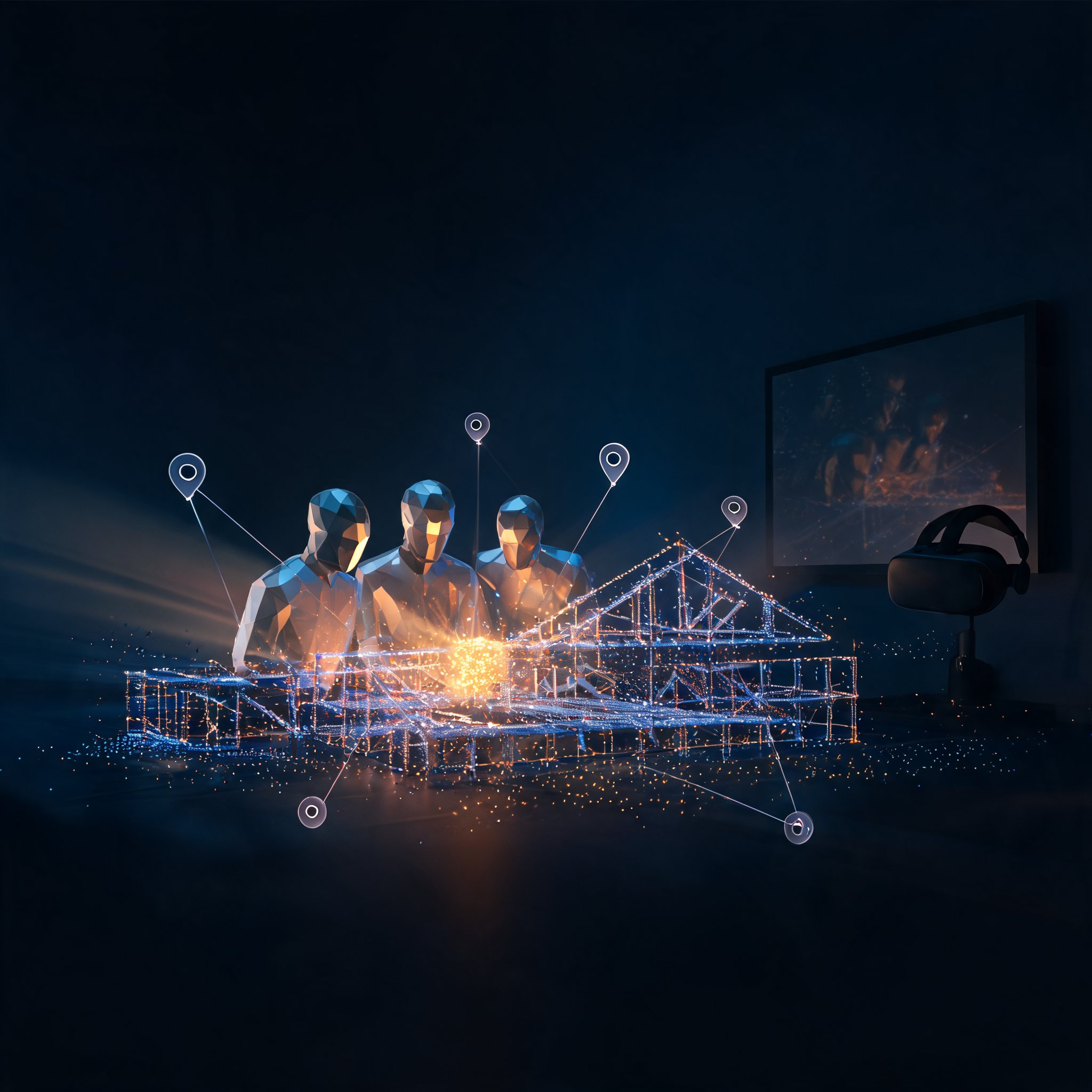
Cintoo has officially launched Cintoo Workspace, an application that lets project teams meet and make decisions inside high-fidelity digital twins streamed directly from 3D scan data. Participants can join a real-time session from a desktop, a VR headset or an immersive room, and the built-in guided collaboration is intended to give virtual reviews the structure of a real site walk.
The company frames the product around a persistent problem: organizations are capturing more reality data than ever, but the teams who need to review it are rarely in the same place. Existing options, as Cintoo describes them, include unstructured meetings in shared 3D spaces where people risk losing track of one another, and video calls in which everyone passively watches one person's low-resolution, screen-shared walkthrough. Decisions then move into follow-up emails, meetings and costly site visits.
Built on scan data rather than design models
Most collaboration tools are built around design models, Cintoo notes. Workspace is an Unreal Engine application cloud-connected to the Cintoo platform and works on scan data captured by terrestrial and mobile scanners, 360 cameras and drones, alongside BIM or CAD models. The combination is meant to let teams review the site as it really is and compare it with how it was designed.
In a session, one person guides the review. Participants opt in to be guided by the leader while staying free to explore on their own, and the leader can gather everyone at one specific location when something needs attention. Role indicators, avatars and a radar keep participants oriented, while shared annotations, measurements and issue features are intended to keep decisions inside the digital twin.
Because sessions stream from the same captured scan dataset rather than a screen share, the guided mode acts as an option each participant can accept or leave, a structure the company contrasts with open shared 3D meetings where attendees can lose track of each other. Joining from whichever device a team member has to hand is part of the same argument.
Company cites the structure of a real site walk
"Simply being in the same 3D space isn't the same as working together," said Dace Campbell, Cintoo's Product & Business Manager, XR & Metaverse. He said teams need the structure of a real site walk, where someone leads, people can break off to check details and everyone regroups to discuss, and that doing this in real scan data on a preferred device is what makes remote reviews work and ultimately enables quicker, more confident decisions.
The announcement did not disclose pricing, general availability timing or named customer deployments. Cintoo directs readers to its website for further information.