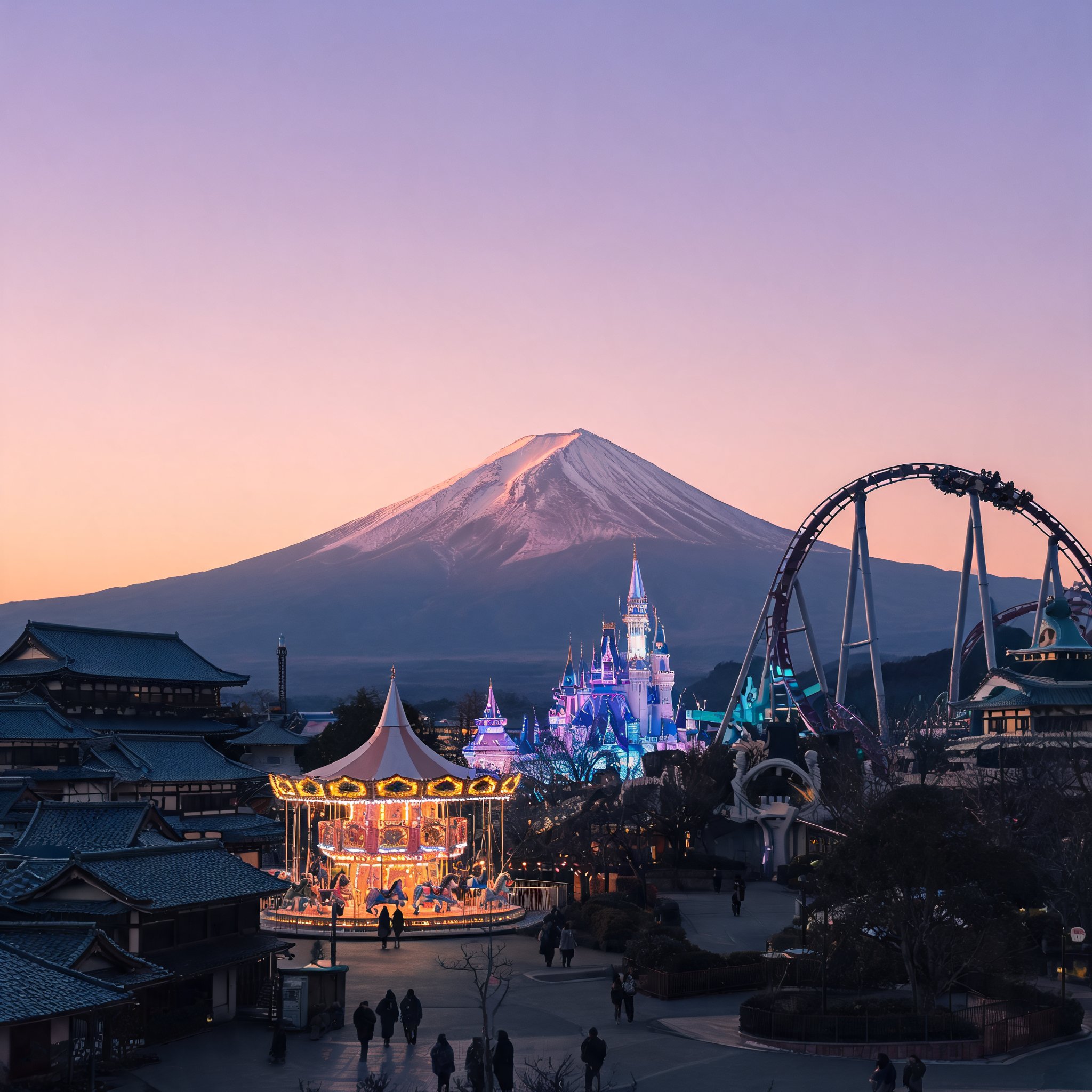
Japan’s theme park landscape is broadening beyond its best-known destination resorts. The country welcomed a record 42.7 million international visitors in 2025, and the article notes that theme parks have become a major draw alongside culture, cuisine and scenery.
Across 18 parks, the common thread is not simply scale. Operators are using intellectual property, immersive themed lands, regional resort development and major capital projects to keep visitors returning. Some of those projects are already open; others are announced or planned.
Destination resorts and the next wave of investment
Universal Studios Japan in Osaka opened in 2001 and has built its identity around licensed worlds including Harry Potter, Jurassic Park and Minions. In 2021 it became the first Universal park to open Super Nintendo World, and in 2024 it added the world’s first Donkey Kong Country area within that land. Limited-time collaborations have featured Demon Slayer, Jujutsu Kaisen, Pokémon, One Piece and Resident Evil, while Sanrio characters have appeared through seasonal shows, parades and entertainment. In 2026, the park announced its first expansion since 2001, with plans to invest up to 300 billion yen in new attractions across 60,000 square metres of nearby land.
Tokyo Disneyland opened on 15 April 1983 as the first Disney theme park outside the United States. Based on the original Disneyland in California, it has seven themed lands: World Bazaar, Adventureland, Westernland, Fantasyland, Tomorrowland, Critter Country and Toontown. Tokyo Disneyland and Tokyo DisneySea are owned and operated by the Oriental Land Company under licence from The Walt Disney Company, making them the only Disney parks not owned by Disney. In 2026, Tokyo Disneyland announced Space Mountain Earthrise and Sugar Rush: Sweet Rescue as part of a 100 billion yen transformation of Tomorrowland, with the new Space Mountain set to replace the original coaster in 2027.
Tokyo DisneySea opened in September 2001, spans 49 hectares and is divided into seven themed ports. Its 2024 Fantasy Springs expansion, described as the resort’s largest to date at $2.2 billion, introduced worlds inspired by Frozen, Tangled and Peter Pan, including Arendelle Castle, Rapunzel’s Tower and Neverland.
IP-driven parks move beyond traditional rides
Ghibli Park, inside the Expo 2005 Aichi Commemorative Park, brings Studio Ghibli films to life across five themed areas. It opened in November 2022 with three lands, added Mononoke Village in November 2023 and completed the five areas with Valley of Witches in March 2024. Although it has no major thrill rides or roller coasters, highlights include a large-scale Howl’s Moving Castle recreation, a My Neighbour Totoro-themed playground and Catbus electric vehicles. In 2026, the park announced plans for a new indoor area inspired by Nausicaä of the Valley of the Wind.
Sanrio Puroland, an indoor park in Tokyo, opened in 1990 and uses Hello Kitty, My Melody and Cinnamoroll in character greetings, parades, shows and attractions. In 2024, Alterface created Cinnamoroll’s Little Big Adventure for its Discovery Theatre. Its outdoor sister park, Sanrio Harmonyland in Oita Prefecture, offers stage shows, parades and family rides; in 2026 it opened Nakayoku Lab, including the Sky Pal Collection AR experience and an AI voice-guided tour.
PokéPark Kanto opened in February 2026 at Yomiuriland in Tokyo as the world’s first permanent outdoor Pokémon attraction. The 26,000-square-metre park has more than 600 Pokémon across Pokémon Forest and Sedge Town, plus a parade and two attractions, Pika Pika Paradise and Vee Vee Voyage. Tickets include admission to Yomiuriland, but the amusement park’s rides require separate tickets.
Legoland Japan opened in Nagoya in April 2017, becoming Japan’s first Legoland park and the second in Asia. It became Legoland Japan Resort in 2018. Its Miniland Japan uses more than 10 million Lego bricks to recreate landmarks such as Tokyo, Kyoto, Mount Fuji, Hiroshima and Nagoya. Moominvalley Park opened in March 2019 in Hanno, Saitama Prefecture, as the second Moomin-themed park in the world and the first outside Finland. Sylvanian Park in Ibaraki is a smaller character attraction within the Komorebi Mori no Ibaraido leisure park.
Thrill parks, culture and regional anchors
Fuji-Q Highland opened in 1968 and is known for record-breaking coasters such as Fujiyama, Eejanaika and Takabisha, alongside views of Mount Fuji. It regularly hosts limited-time collaborations with anime franchises including Demon Slayer, Evangelion, Gundam and Pokémon.
Nagashima Spa Land opened in 1966 and has 13 operating coasters, more than any other amusement park in Japan, including the world-famous Steel Dragon 2000. It is part of the wider Nagashima Resort, which combines thrill rides with a water park, hot springs, shopping and seasonal events, and is also home to the flower park Nabana no Sato.
Huis Ten Bosch opened in 1992 in Sasebo, Nagasaki Prefecture. At about 152 hectares, it is Japan’s largest theme park by area, recreating a Dutch town with canals, windmills, gardens and historic-style buildings. In 2025, working with Brogent Technologies, it opened Japan’s first premium flying theatre with an 8K LED dome screen. Its Miffy connection now includes Miffy Wonder Square, which opened in 2025.
Yomiuriland in Tokyo’s Tama Hills has more than 40 rides and attractions, including the Bandit coaster that reaches up to 110 km/h. It attracted around 2.4 million visitors in 2024, its 60th anniversary year, and has welcomed more than 70 million visitors since opening. Hirakata Park, Osaka’s oldest amusement park, dates to 1910, draws around 1.3 million visitors a year and has 45 attractions, including the Elf wooden coaster and Red Falcon. Greenland in Kumamoto is among Kyushu’s largest parks, set in a 300-hectare resort and featuring around 80 attractions, a 105m-high Rainbow Ferris wheel and the NIO and Milky Way coasters.
Cultural and heritage parks offer a different proposition. Edo Wonderland Nikko Edomura recreates an Edo-period town across 49.5 hectares, with period costumes, theatre shows, ninja performances, archery and shuriken throwing, plus film sets and the mascot Nyanmage. Asakusa Hanayashiki, established in 1853, is considered Japan’s oldest amusement park; it began as a botanical garden and became a ride-based park in the 1940s, and it still operates Japan’s oldest surviving roller coaster, built in 1953.
What the expansion signals
The pattern is clear: Japan’s theme park growth is being driven by IP-based immersive lands, large-scale resort investment and regional attractions that give visitors reasons to travel beyond Tokyo and Osaka. The record inbound tourism figure provides a favourable backdrop. At the same time, several of the most significant projects are plans or announcements rather than completed facilities, and access conditions vary. Ghibli Park has no major thrill rides, for example, while PokéPark Kanto’s rides are separate from its Yomiuriland admission. The sector’s next phase will depend on how these investments are delivered and how effectively parks convert record visitor interest into repeat visits.