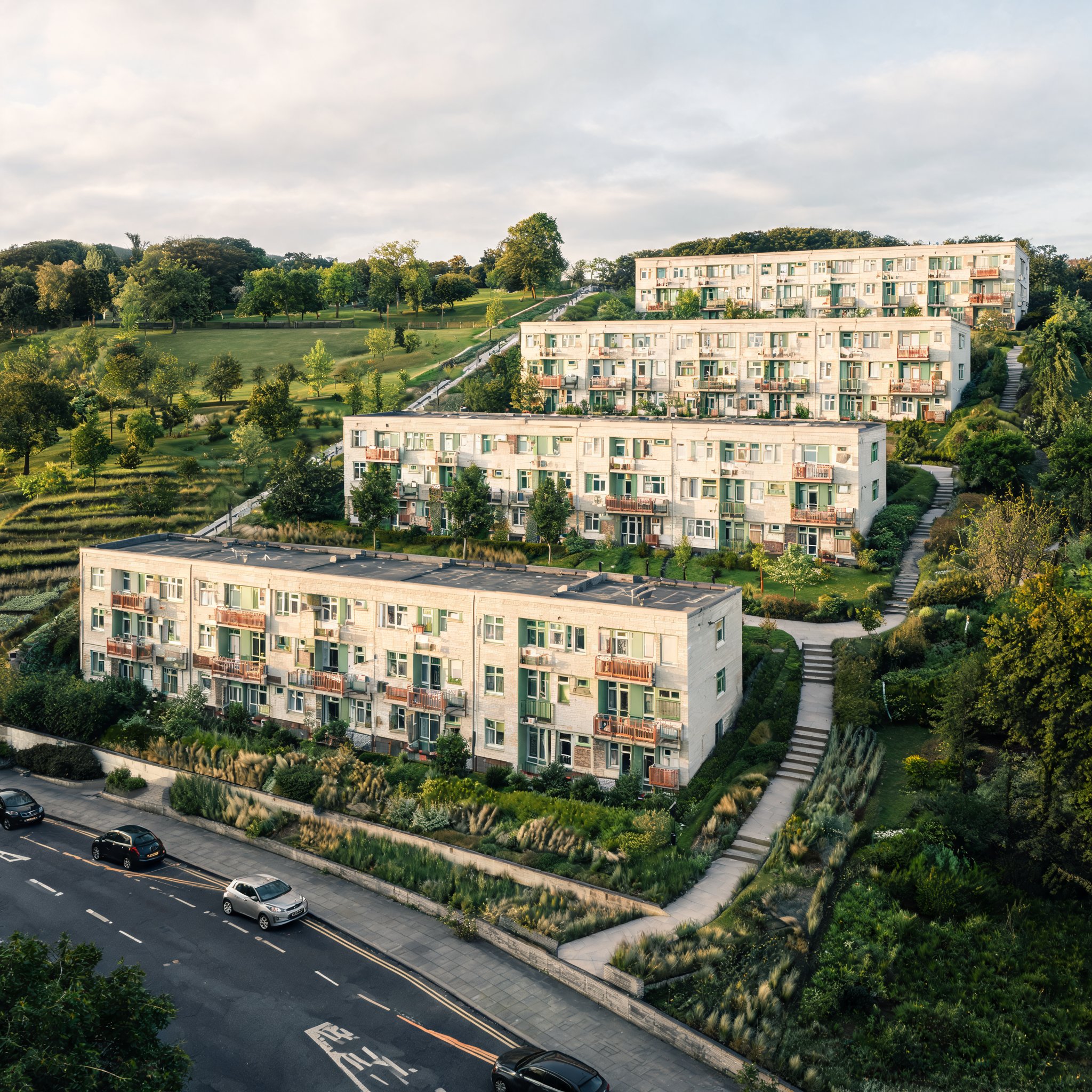
Lion Green Road, a 157-home council housing scheme in Coulsdon, south London, has been awarded the RIBA Stirling Prize 2026. The development was designed by Mary Duggan Architects with RUFF Architects and built for Croydon Council by main contractor CField Construction under a £34m deal.
The scheme replaces a former car park on a sloping site whose level changes by eight metres from one end to the other. Its five blocks are arranged to work with those changes in height and with the views they open up, forming a link between the busy Lion Green Road and an area of green parkland beyond. The layout is intended to create what the project describes as a new “living landscape” for 635 residents.
Design and site response
Rather than flattening the site, the design uses its gradients and outlooks to organise the homes. A consistent specification is combined with small variations in the height and orientation of the blocks, an approach the jury said delivers housing at scale without uniformity. The architects describe the result as a new kind of garden neighbourhood that sets privacy and generous views alongside a strong connection to nature.
Construction and carbon
The project team attributes part of the scheme's environmental performance to the way it was built. Efficient construction methods, simple finishes and a more streamlined building process are credited with allowing Lion Green Road to cut carbon emissions, although the announcement did not set out quantified savings.
- Homes: 157 across five blocks
- Client: Croydon Council
- Main contractor: CField Construction
- Contract value: £34m
- Architects: Mary Duggan Architects with RUFF Architects
- Site: former car park with an eight-metre change in level
- Residents served: 635
What the jury said
Chris Williamson, RIBA President, speaking on behalf of the Stirling Prize jury, said the scheme demonstrated that density can be achieved without compromising the quality of the places created, at a time when more homes are urgently needed. He said the consistent specification, varied subtly in height and orientation, offers housing at scale without uniformity, and that the architects had produced a new kind of garden neighbourhood balancing privacy and generous views with a strong connection to nature.
He described the result as thoughtful, resourceful architecture, and said it showed that even the most challenging sites can be transformed into distinctive places for people to call home.