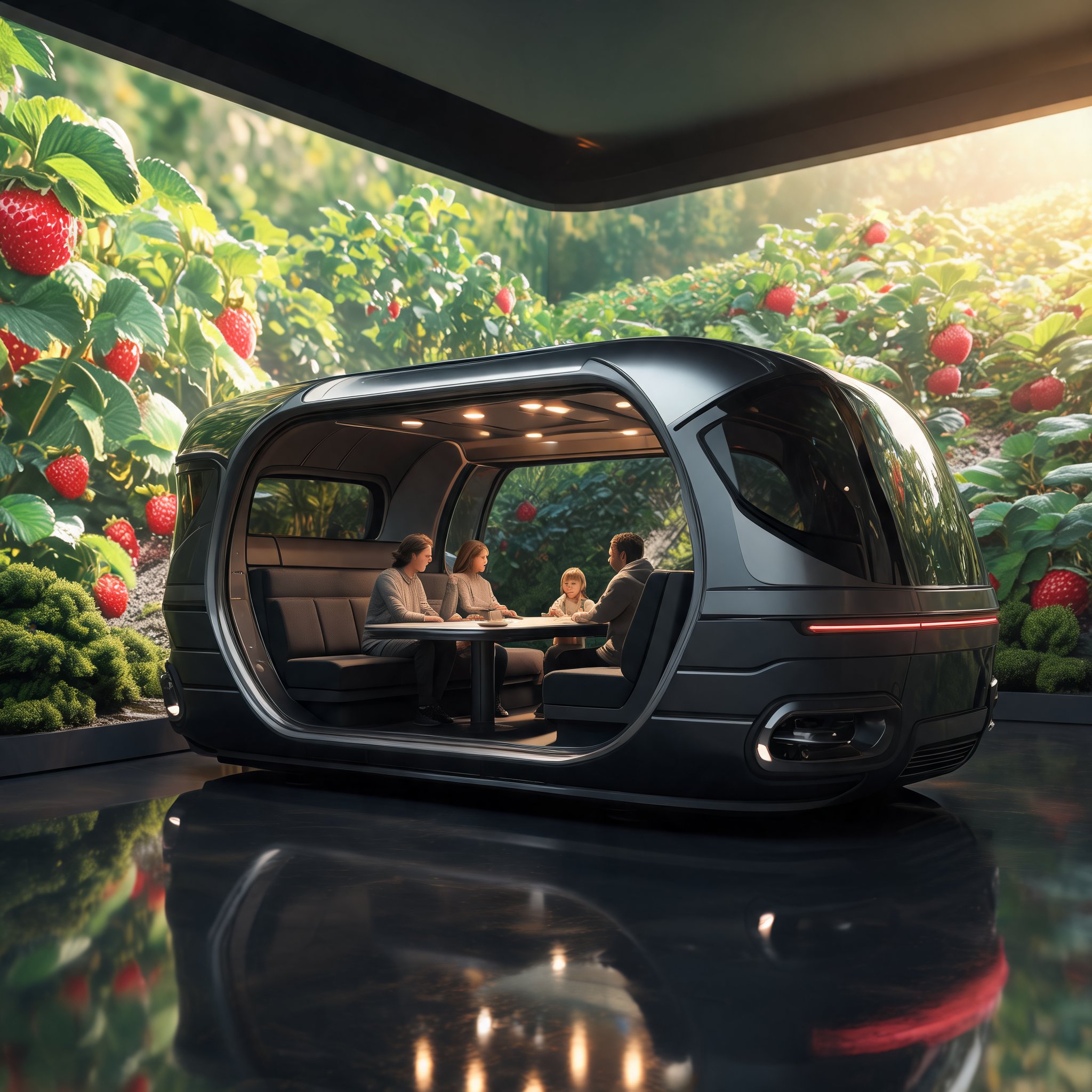
MACK One has introduced eatX, which it describes as the world’s first dark ride dining attraction: a patented, commercially deployable format in which the meal and the ride are designed as one experience rather than consecutive activities.
Guests would board the FlowDiner, an autonomously moving, battery-powered dining vehicle developed and manufactured by MACK Rides. Each vehicle carries up to four adults and two young children through a sequence of immersive themed environments. Projection, set design, lighting, sound and cuisine are intended to advance the story at the same time. MACK One stresses that neither element is supplementary: the food is not treated as decoration for the ride, and the ride is not presented as packaging for the food.
A new attraction and dining category
According to MACK One, eatX does not fit existing attraction or restaurant typologies. It is positioned at the intersection of ride engineering, immersive storytelling and system gastronomy. The commercial argument is that the format uses the same floor area for both attraction and dining revenue, responding to space constraints, demand for high-value guest experiences and the need to raise revenue per square metre. Those are the company’s stated objectives; the announcement did not include independent performance data.
The FlowDiner took two years to develop. It travels at up to 0.5 metres per second, uses an on-board electric drive and forms part of a trackless ride system. Because the vehicles do not depend on a fixed track, MACK One says the layout and narrative route can be configured for different operators and intellectual properties. The platform is also intended as a white-label concept, allowing an operator to localise the story, brand and destination context.
First installation planned for Germany
The first eatX installation is scheduled to open at Karls Erlebnis-Dorf in Elstal, near Berlin, in summer 2027. The attraction, called Strawberry Dining Journey, is planned to move guests through five themed worlds during a three-course menu. Its story is built around the documented discovery of the garden strawberry in 1714 and is intended to reflect Karls’ brand themes of family, farming and authenticity. MACK One says the production will use projection, set construction, lighting and choreographed cuisine. The narrative is the same for each guest, while the company frames the memory as unique to each table.
Built on an earlier dining prototype
MACK One presents eatX as a product of operating experience rather than a design-studio concept. The MACK Group developed Eatrenalin, which the company describes as a Michelin-starred immersive fine-dining restaurant at Europa-Park Resort, as an earlier prototype combining dining and storytelling. MACK Rides contributes engineering experience, while MACK One serves as the group’s innovation and experience-design engine. The company says this background gave eatX technical credibility and evidence of guest appetite before the first commercial unit was built.
Commercial scope and limits
MACK One sees potential applications in theme parks, resorts, family entertainment centres, malls and stadiums. In parks, the format is pitched as a way to turn underused or legacy space into a high-value destination; in resorts, as a way to make transitional dining part of the central story; and in other venues, as an anchor that can increase dwell time, per-capita spending and social sharing. The company also describes the model as scalable, brand-agnostic and operationally lean, with system gastronomy intended to support precision, throughput and quality.
Those benefits remain projections until the first installation opens and operators can assess throughput, food quality, staffing and guest response in practice. The Karls Erlebnis-Dorf project will therefore be the first public test of whether eatX can deliver the dual-use model it proposes.