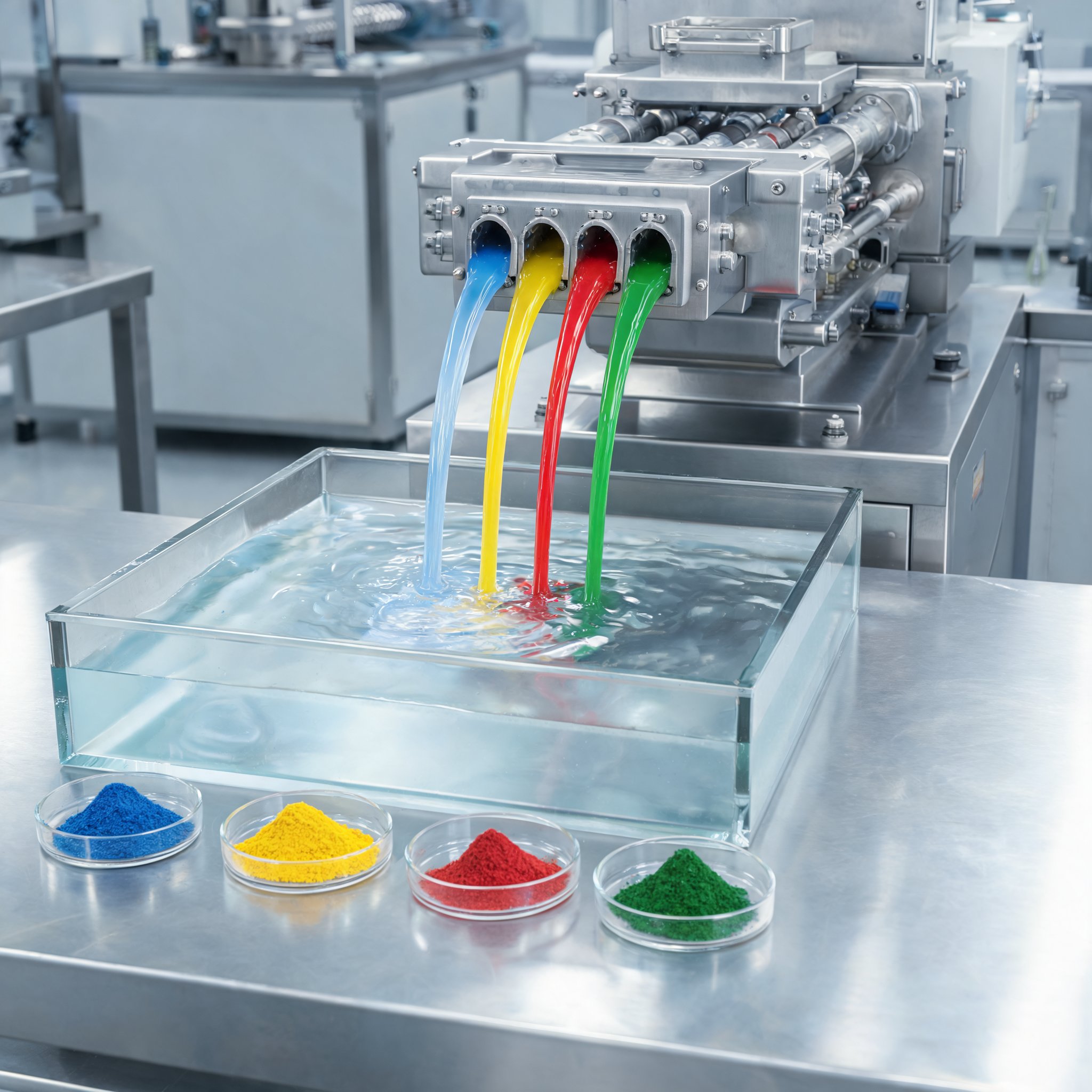
Natural colorants may offer a lower-impact alternative to conventional pigments in biodegradable plastics, but their ability to survive melt processing depends heavily on the polymer and the pigment. A new study examined four commercial natural pigments—blue spirulina, yellow curcumin, red beetroot and green chlorophyllin—in polylactic acid (PLA) and polybutylene succinate (PBS).
The researchers produced color masterbatches by twin-screw extrusion, then diluted them into the matching polymer at 2, 4 and 6 wt% and injection-molded test specimens. The formulations also contained titanium dioxide, calcium carbonate and stearic acid, added to support UV protection, dispersion and processing.
Thermal limits shape the processing window
Heat was the main constraint. Thermogravimetric analysis found degradation onset temperatures of about 229 °C for spirulina, 244 °C for curcumin, 258 °C for chlorophyllin and 267 °C for beetroot—below those of PLA and PBS. The team therefore used temperature profiles that melted each polymer while limiting pigment exposure: 145 °C for PBS and 190 °C for PLA. The twin-screw extruder ran at 65 rpm with a feed rate of 2 kg/h.
Most pigment–polymer combinations fit this window, but spirulina did not. During PLA processing it lost its characteristic blue color, so a blue PLA masterbatch could not be produced. PBS, processed at the lower temperature, preserved enough pigment stability for successful compounding. The result highlights how strongly pigment compatibility depends on the matrix’s thermal requirements.
Flow and mechanical effects remain modest
From a processing standpoint, the pigments caused limited changes in rheology. Melt flow rate fell slightly after incorporation, indicating a modest rise in melt viscosity. Neat PLA showed an MFR of about 50 g/10 min, and the natural-pigment masterbatches stayed close to that value; PBS showed a similar, minor reduction.
That matters for compounders because a color system loses practical value if it demands major changes to screw design, pressure settings or molding conditions. In this work, conventional twin-screw compounding and injection molding handled most formulations without major problems.
The researchers also checked tensile and impact behavior. Across the 2–6 wt% range, neither PLA nor PBS showed significant losses in overall mechanical performance. PLA began with a Young’s modulus of about 1710 MPa and tensile strength of 65.6 MPa; PBS began at about 392 MPa and 34.5 MPa. Colored formulations stayed close to those baselines. Impact strength remained in a similar range, although individual pigments caused some variation.
Color fastness is the larger barrier
Successful extrusion did not ensure long-term color stability. After 50 hours of xenon-lamp exposure, most formulations showed a color difference above ΔE* = 2, a level generally considered visually perceptible. The PLA formulation with 2 wt% green chlorophyllin masterbatch was the main exception and showed the highest photostability.
The study therefore identifies UV stability as the biggest obstacle to broader use. Packaging, consumer products, agricultural parts and outdoor applications may need additional stabilization, protective coatings or pigment modification before natural colors can compete with conventional systems over long service periods.
The environmental comparison favored the natural pigments under the study’s assumptions. One kilogram of curcumin pigment generated about 0.04 kg CO2-eq, compared with 18.65 kg CO2-eq for the inorganic green reference pigment. The natural-pigment masterbatches also used less electricity during extrusion and pelletizing.
Even so, the researchers conclude that natural pigment masterbatches need further development, especially in lightfastness and thermal stability. The study shows that several natural colorants can be compounded into PLA and PBS on conventional equipment with limited changes in melt viscosity and mechanical performance. Future work should focus on preserving color during processing and subsequent service exposure.