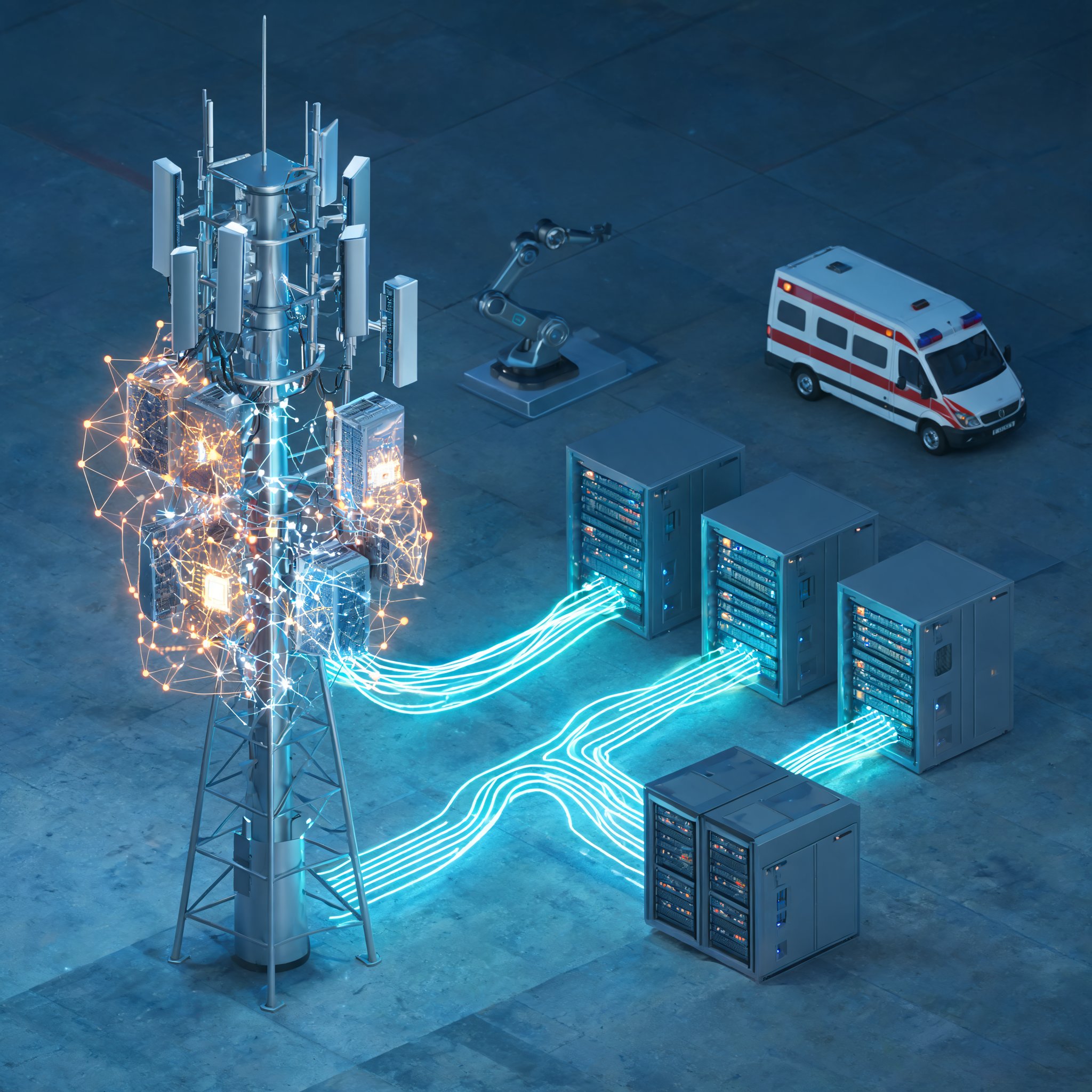
Nokia and NVIDIA are widening their AI-RAN collaboration beyond lab work, with Nokia running anyRAN trials with BT, Deutsche Telekom, Elisa and Orange and nearly 20 operators having publicly announced AI-RAN projects built on Nokia’s anyRAN software and NVIDIA’s Aerial RAN Computer.
Nine operators across Europe, the Middle East and Africa are now building or expanding NVIDIA-powered infrastructure, according to the companies. The work spans radio access network software, accelerated computing and operations tooling, rather than a single 5G feature.
The reference design combines Nokia’s anyRAN with NVIDIA’s Aerial RAN Computer, CUDA, Nemotron open models and Agent Toolkit. Nokia has embedded the software into its Autonomous Networks Suite and into third-party operations software from Cisco, TCS and NTT DATA. Dell, QCT and Supermicro supply ARC-ready servers, while Red Hat OpenShift provides the cloud-native foundation.
Nokia argues that operators can use assets they already control — land, power, buildings, spectrum and fibre — to add accelerated compute at centralised, metro and cell sites. That would place AI models closer to the machinery, emergency responders and handsets that use them, and allow the radio itself to run inference. In lab measurements, Deutsche Telekom and Nokia recorded typical uplink throughput improvement of 10% to 15% for AI-based channel estimation.
That is a modest initial return for a distributed compute build-out. Backhaul becomes the limiting variable once inference moves outward, and Nokia’s 800G coherent pluggables signal the inter-site capacity the company expects operators to need.
The operator work covers different workloads. Elisa completed Europe’s first AI-RAN field trial, running voice, mobile data and vision AI together on one accelerated platform over 5G. Orange is introducing voice intelligence services for enterprises and emergency responders. Deutsche Telekom is working on physical AI for industrial customers, and BT is preparing live trials in the UK.
NVIDIA founder and CEO Jensen Huang framed the shift as telecom networks adding intelligence to their existing role of carrying conversations. He said leading operators are turning land, power and connectivity into distributed AI infrastructure, bringing intelligence closer to industries, people and robots. With Nokia, he said, accelerated computing is being extended into the radio network itself to create a foundation for AI-native 5G.
Pallavi Mahajan, Nokia’s chief technology and AI officer, said the next era of connectivity would be defined by networks that distribute intelligence, continuously optimise performance and enable new AI-powered services, including physical AI. She said the combination creates a software-defined foundation for operators to get more from spectrum today and to prepare for more autonomous, AI-native 6G networks.
The architecture also creates dependencies. Stacking anyRAN, ARC, CUDA and Nemotron into one reference design shortens integration, but ties operators to NVIDIA’s programming model at the radio layer, with Nokia’s RAN software above it. Cisco and Nokia are also folding Nemotron open models into autonomous-network software, extending that dependency into operations tooling.
Commercial questions remain. Until AI-service revenue materialises, operators carry the financing for distributed compute and backhaul, while suppliers of accelerated compute and RAN software hold the layer where incremental value would accumulate. The disclosed checkpoints cluster in 2027: BT’s Birmingham live trial, Deutsche Telekom field trials and Elisa’s distributed deployment with commercial AI-RAN services are all slated for then.