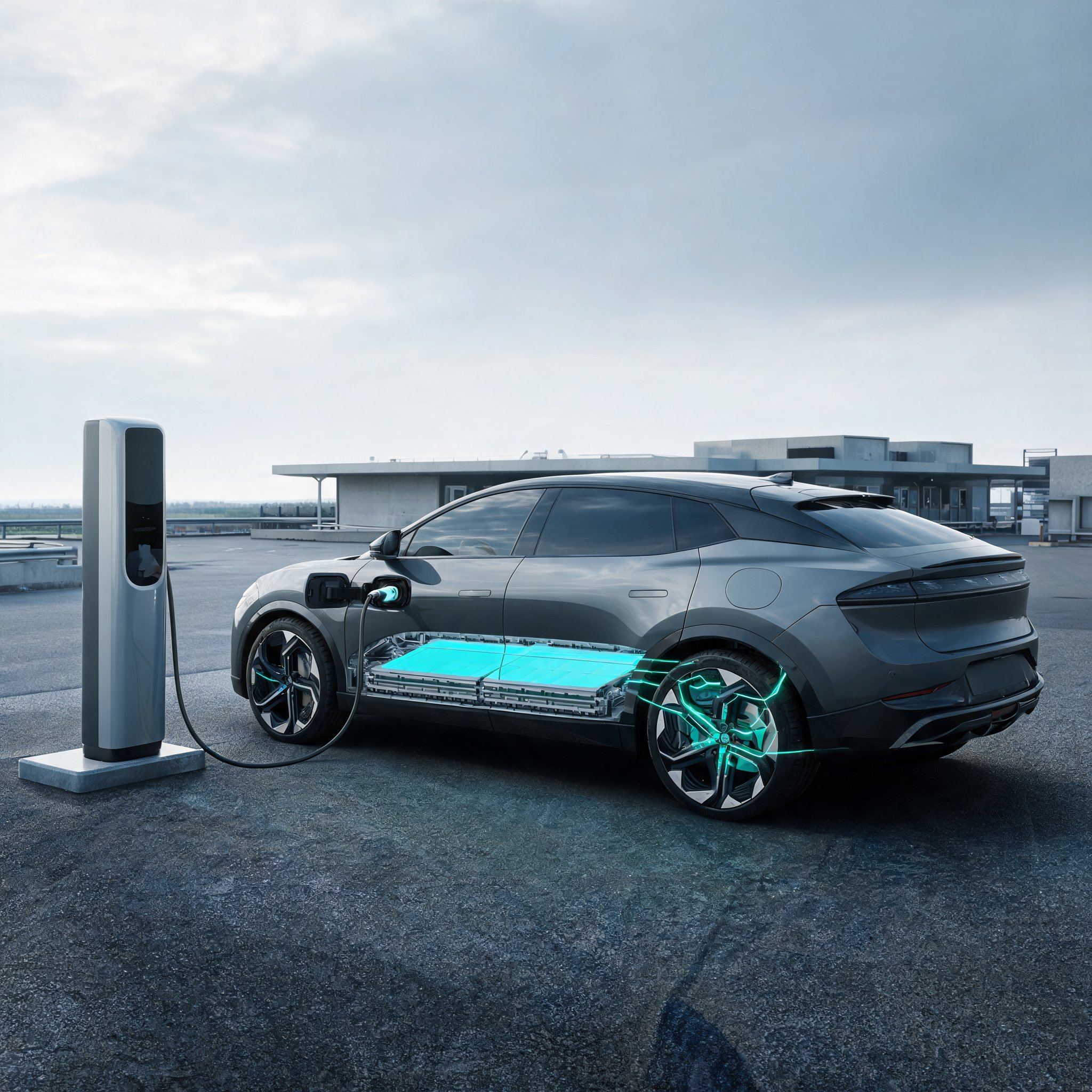
Porsche has extended its largest SUV range with a battery-electric variant, the Cayenne Electric. After a world premiere in November 2025, series production began in Bratislava at the start of February 2026, initially with base and Turbo models; the S variant in Coupé form followed in March. The S Coupé is the subject of this driving report, positioned between the base model and the Turbo and built on the Premium Platform Electric (PPE) that also underpins the Macan Electric.
Three power levels, one architecture
The S delivers up to 400 kW in normal driving and 490 kW with Launch Control. The base model provides 300 kW (325 kW with Launch Control), while the Turbo reaches 630 kW (850 kW with Launch Control). Porsche quotes 0–100 km/h in 3.8 seconds and a 250 km/h top speed for the S; the base model takes 4.8 seconds and reaches 230 km/h, and the Turbo takes 2.5 seconds and reaches 260 km/h.
For the Cayenne, Porsche redeveloped two central components beyond the Macan's capabilities: the battery is more deeply integrated into the vehicle structure, and the S and Turbo use an oil-direct-cooled rear-axle motor. The optional Porsche Active Ride adaptive suspension is used here for the first time in an SUV. Both axles use permanently excited synchronous machines; the front motor is essentially derived from the Macan, while the rear unit was specially developed for the S and Turbo, with the Turbo's higher output coming from a longer version of the same design rather than a different motor. The base model relies on a water-cooled rear drive.
Oil cooling and efficiency
An electrically non-conductive oil draws heat directly from the copper windings, whereas conventional water-jacket cooling requires heat to reach an outer jacket first. Porsche states the motor efficiency is up to 98 per cent and cites this more efficient cooling as one reason the S achieves slightly higher range than the base model despite its greater power. On the road, the S accelerates smoothly and forcefully without Launch Control, and repeated full-throttle bursts did not produce an early power cut-off.
Charging is the strongest argument
The drivetrain draws on a battery with a gross energy content of 113 kWh, of which around 108 kWh is usable. Porsche uses six modules with 192 pouch cells, a change from the Macan's prismatic cells. The chemistry is also new: a nickel-rich NMCA cathode (around 86 per cent nickel) and an anode with six per cent silicon raise energy density by roughly seven per cent over NMC-811, so the pack holds eight kilowatt-hours more than the Taycan's while being around 103 litres more compact.
Porsche tunes the charging curve to peak early. According to a technical deep dive, over 300 kW is available from roughly five per cent state of charge, with the theoretical maximum near 55 per cent. In the reporter's own recording at an EnBW HyperCharger, the session began at nine per cent SoC; at 12 per cent, 333 kW was already available, rising to about 360 kW from 13 per cent and reaching a maximum of 386 kW at 44 per cent. The full 390 kW on the data sheet was not reached because of the charger rather than the car: Porsche provides 390 kW only above 520 amps, while the HyperCharger supplies a maximum of 500. For 400 kW, Porsche specifies an even narrower window: over 850 volts, a battery temperature of 40 to 42 degrees Celsius and an SoC of 45 to 48 per cent.
What matters for the shortest possible stop is the time to 80 per cent. After the first drop in power, the Cayenne continues at around 290 kW, holds roughly 270 kW between about 60 and 71 per cent, and still draws 183 kW at 80 per cent before falling sharply thereafter. From 10 to 80 per cent took about 16 minutes on the reporter's timer, matching the configuration figure.
Quiet Charging and its limits
A downside emerged during the first fast-charging session: the cooling fans are noticeably loud during fast charging and for a short time afterwards. A second session using Quiet Charging at the same charger was noticeably quieter, yet 10 to 80 per cent still took 16 minutes. Peak power was almost identical at 385 kW, though the curves differ: in Quiet mode the high plateau ends at 42 per cent, so at 44 per cent the car drew 325 kW against 386 kW in Normal mode, after which the values ran closer together.
Quiet Charging is activated manually via the display after charging has started and only reduces fan speed, lowering cooling performance and letting the battery heat faster. Porsche told the reporter that a single measurement cannot be generalised and that under moderate conditions only the volume decreases; outside temperatures during the tests were around 20 degrees. A noticeable reduction in performance occurs only at high starting battery and ambient temperatures — Porsche's example is a 10–80 per cent session with a starting battery temperature of 35 degrees and an ambient temperature of 45 degrees, which can extend charging by around one minute.
Pre-conditioning is triggered automatically through the Charging Planner once a charging stop is set as a navigation destination, and Porsche offers no manual option, so a spontaneous stop without route guidance cannot specifically pre-heat the battery. Battery temperature and the charging power possible at that temperature are shown on the driver information display. Two cooling plates per module heat or cool the cells from above and below, and Porsche says the pressure fans used require around 15 per cent less energy than conventional suction fans.
A 2.56-tonne chassis, managed but not hidden
The data sheet lists a kerb weight of 2,560 kilograms for the standard S Coupé. Adaptive air suspension with electronic damper control is standard; the test car added Porsche Active Ride at €8,324. Its active dampers connect to a motor-pump unit on each axle and generate targeted forces at each wheel without mechanical stabilisers. In Comfort mode the system can overcompensate for roll and pitch, and the Cayenne does not lean outward in corners but slightly into the curve. Sport and Sport Plus keep the body flat without becoming uncomfortably hard, and combined with precise steering and rear-axle steering the S feels more agile than its size and weight suggest. The weight is not completely masked: pushed too far, the S understeers out of the curve, and the 22-inch wheels transmit short, sharp edges into the cabin.
Regenerative braking is integrated into the brake pedal, with the friction brake supplementing it as needed, and the transition is almost imperceptible. The ceramic brake system on the test car with black callipers costs €10,100, but the reporter notes it is not a prerequisite for everyday energy recovery. Rear-axle steering, at just under €1,700, is highly recommended because it shrinks the turning circle from 12.7 to 11.6 metres.
Efficiency, range and running costs
On mixed routes of city, country roads and motorways, consumption varied between around 20 and 27 kWh/100 km depending on speed. Gentle driving approached 20 kWh, everyday mixed driving settled around 24 kWh/100 km, and higher motorway speeds were just under 27 kWh/100 km. With around 108 kWh usable, 24 kWh/100 km equates theoretically to about 450 kilometres on a full charge, or around 315 kilometres using the 80 to 10 per cent window. These on-board figures are not directly comparable to WLTP, which also includes charging losses.
For the tested configuration, Porsche states a combined WLTP range of 616 kilometres, while the S Coupé model range extends up to 669 kilometres and the S with SUV bodywork reaches up to 653 kilometres. Among Coupé variants, the base model reaches up to 661 kilometres and the Turbo up to 637 kilometres. For longer parking periods, the optional 22 kW AC charger in the test car costs €1,666 and cuts the specified 0 to 100 per cent time from 11 to 5.8 hours; 11 kW is standard. Since the model year change in September 2026, inductive charging has also been available to order: Porsche Wireless Charging at 11 kW and around 90 per cent efficiency costs €5,117.
Cockpit, cargo and towing
The infotainment is operated via a curved Flow Display, and the test car also included a passenger display and a head-up display with augmented reality. A separate control strip gives direct access to volume and climate settings. Some functions are buried in submenus and the navigation map sometimes moves abruptly, though the optional surface heating at €934 — warming armrests and door panels — drew praise. The Coupé's flatter roofline slightly reduces practicality compared with the SUV: the luggage compartment holds 534 to 1,347 litres plus 90 litres in the front trunk, with only the Turbo offering less at 500 litres, and rear headroom is tighter but still sufficient. All three electric Cayenne variants can tow up to 3 tonnes when braked, rising to 3.5 tonnes with the optional Off-Road Package at €2,492.
Price, positioning and what transfers
The S Coupé starts at €130,300; the tested configuration adds €69,440 in options for a total of €199,740. Active Ride, the ceramic brake system and the lightweight sport package alone account for €34,589. The reporter observes that a modest entry price paired with a long, high-priced options list is closer to the rule than the exception at Porsche, and that substantive features such as Active Ride are the exception. The evaluation therefore carries a caveat: the driving experience with active suspension and rear-axle steering cannot be directly transferred to a standard base S, whereas the large battery and high DC charging power are already part of the basic technical offering.
In competition, the S faces the BMW iX5, the Mercedes EQS SUV and the Audi SQ8 e-tron, while the more closely related Audi Q6 e-tron and Porsche's own Macan Electric rank one class below. The electric Cayenne is aimed at a wealthy, brand-loyal clientele that configures its vehicles consciously and lavishly, accepting the extensive options list as part of the package.