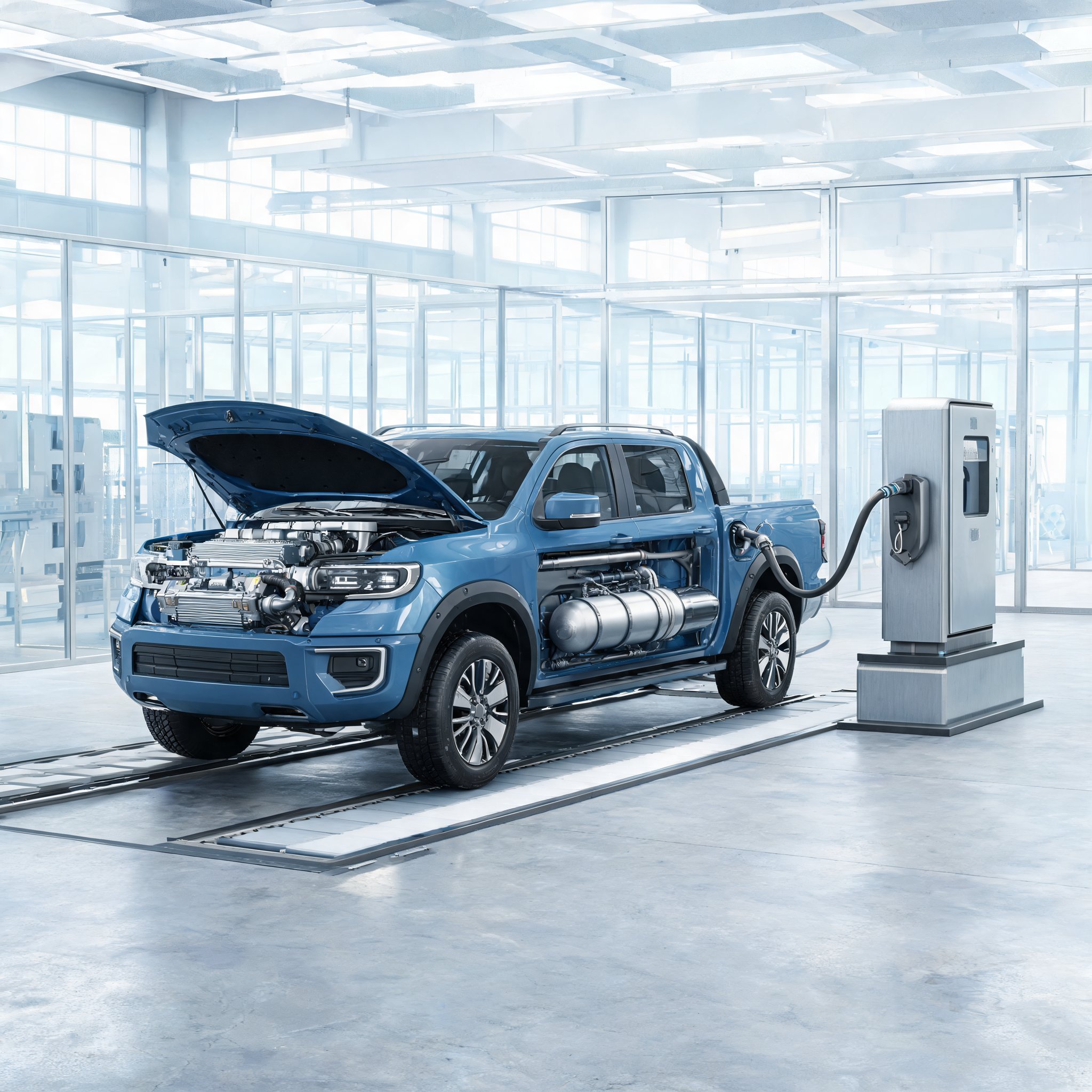
Thailand’s Board of Investment (BoI) has approved Toyota’s 1.49 billion baht (about €39 million) investment in its Ban Pho plant in Chachoengsao Province to produce the Hilux FCEV. The board said the project would be the first hydrogen fuel-cell electric vehicle manufactured in Thailand.
Toyota is adding a new production line for the hydrogen-powered Hilux at Ban Pho, where the ninth-generation model is already built as an internal-combustion, mild-hybrid and battery-electric vehicle. The company expects to begin Hilux FCEV production in December 2027. It also plans an on-site hydrogen refuelling station to support manufacturing and testing of the vehicle.
Export-first plan with limited volume
Although Toyota launched the Hilux BEV in Thailand before any other market worldwide, the Hilux FCEV will initially be built only for export. The BoI said European countries, Australia and New Zealand will be priority markets. Toyota plans to make about 3,000 Hilux FCEVs a year, indicating that it views the derivative as a niche product rather than a high-volume replacement for existing Hilux variants.
The vehicle was previewed at IAA Transportation 2026, where Toyota released the first teaser images. They indicated minor styling differences from other ninth-generation Hilux models. One image showed a daytime running light pattern with three separate segments along the upper edge of each headlamp. Another suggested a closed upper grille area, similar to the Hilux BEV. The teaser vehicle appeared to use a paint similar to the Force Blue colour Toyota offers on the Mirai.
Performance targets and Dakar testing
Toyota is targeting a towing capacity of up to 2.5 tonnes and a driving range of more than 400 kilometres for the Hilux FCEV. The company plans to launch the model in 2028. Before that, its motorsport division, Gazoo Racing, is likely to test the underlying technology in the DKR GR FC Hilux at the Dakar Rally’s Future Mission 1000 category in 2027.
The rally-specific hydrogen-powered Hilux has two fuel-cell stacks with a combined output of 400 kW and four high-pressure hydrogen tanks with a total storage capacity of 8.4 kg. Data gathered during the Dakar Rally could help Toyota refine its fuel-cell technology for the Hilux FCEV, linking the competition programme with the planned production model.